By Ave Arroyo, PTMA Student
It’s that time again for an Oyster Blog! This will be our second-to-last blog, as our spat will be released into Chuckanut Bay on June 10th! Learn about Northwest Maritime’s oyster restoration project here.
Our many bags of Pacific Oyster shells that have our Olympia Oyster spat growing on them will be carefully set down on the floor of Chuckanut Bay in Bellingham during a small tidal window. Since these young oysters are susceptible to more predators at their current stage, they will be kept in the netted bags until August.
During their time in protection, they will do what oysters do best. They will sense the environment around them and adapt in order to survive. These shellfish are incredibly intelligent. If they sense strong tides around them or predators looking to swipe them from the rocks and crack them open, they will consciously adapt to strengthen their muscles as they grow, in order to stay tightly shut and stuck to the surfaces they reside on.
In August, when our spat have adapted accordingly, we will cut open the bags and spread the shells out into their own little nursery so that they can grow more naturally and hopefully restore some of the Olympia Oyster population.
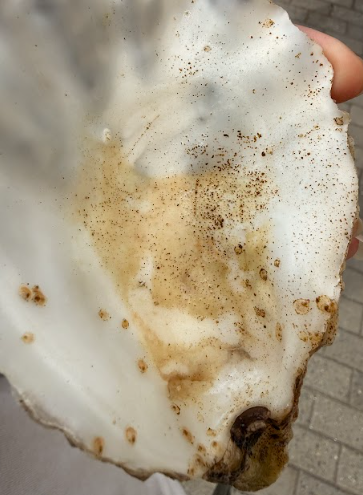
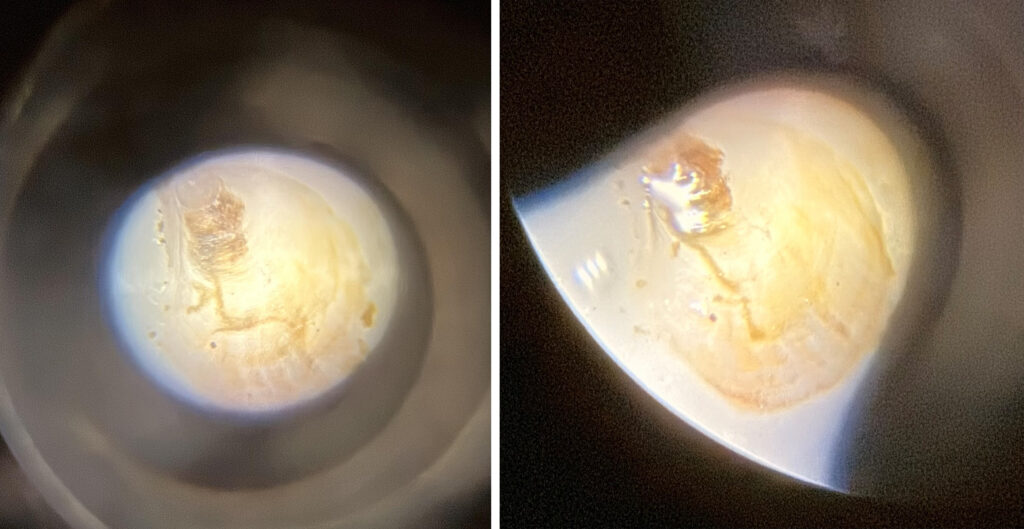
Right now, our spat have grown quite a bit since the last blog, at first they were the size of a pencil graphite tip, now it’s much easier to see them without even a magnifying glass! Their shape is very visible; they are now more like the teeny versions of the oysters they will soon grow to be.
They have grown in little clusters along the shells, as they do not like to settle in solitary. When one oyster finds a good spot, it means they all have found a good spot.
For us caretakers, volunteers, and supervisors, seeing an organism grow from something microscopic to something clearly seen with the naked eye is worth all the work and time.
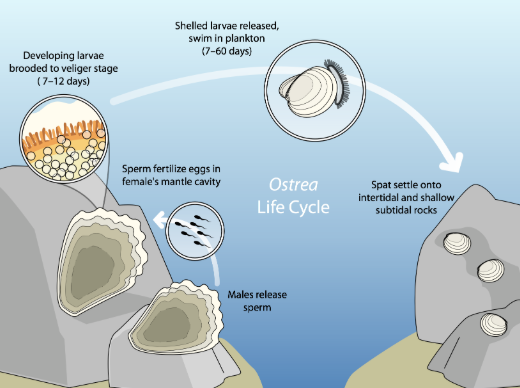
Our spat started out as free-floating larvae, looking for a place to settle.
What’s next for our youngsters?
Our spat have settled on all the ‘cultch’, which is any hard material—such as old shells or rocks—that are placed into the water on purpose for the spat to grab onto.
Now that these oysters have finally settled, they can no longer move around.
Eventually, they will metamorphose into a juvenile stage, where they feed on plankton and gather nutrients in the water to build up their anatomy.
It will take years for our Olympia Oysters to reach full maturity, both physically and reproductively. But when they do, they will become shelters and sanctuaries for all sorts of marine life. This is one of the reasons why they are so important to our ecosystem.
Once their shells have developed, the cycle will continue. Oyster larvae will plant themselves and grow on top of those newly built-up shells and mature, following more larvae and more growth.
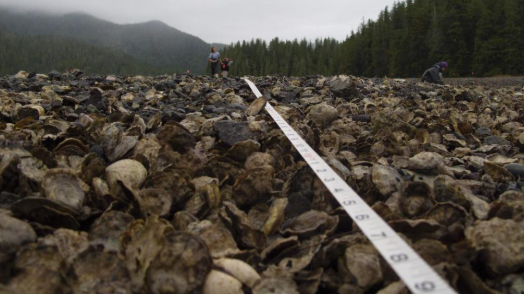
Generation after generation of oysters settling on top of one another will become a living reef of oysters, or an oyster bed, which is exactly what we want.
Recently, the spat were officially counted!
This count was extremely thorough.
One bag was taken from the bottom of the tank, the middle of the tank, and the top of the tank.
Then three shells were taken from each bag, from three different sections of said bag.
The final count was exactly 413,625 young oysters produced at Northwest Maritime Center! This is incredibly lucky, considering the average mortality rates. At the beginning of this project, it was estimated that there would only be around 200,000 oyster spat in total, so we have doubled our number! Tank 1 had an average of 11.97 spat per shell, while Tank 2 had an average of 21.12 spat per shell. The minimum expectation for our population was about 4 spat per shell, but the number we were going for was about 10-20 spat per shell, so we have perfectly met the quota we had hoped for.
This year in oyster restoration was full of trial and error, and lots of new things to learn. Out of the three organizations that worked on this project, none of them had ever done an out-of-water system. Most systems are exactly like the aquarium in Fort Worden; they pull water directly from the ocean, and this was the first time we worked with a system that was entirely simulated and controlled by us.
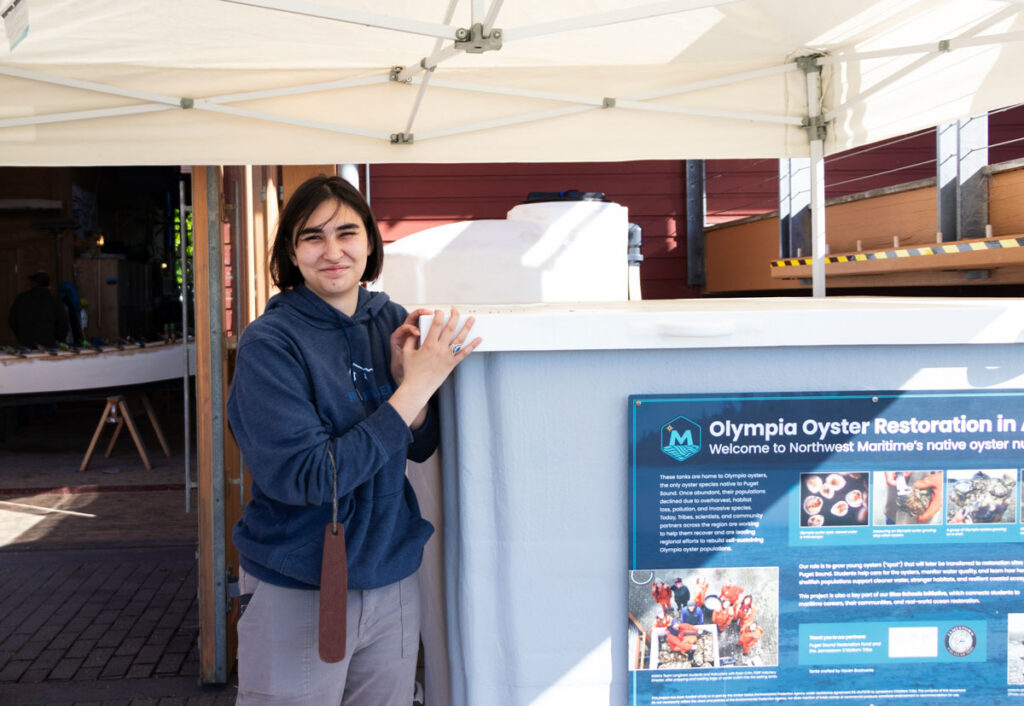
As you can imagine, it was a lot of moving parts. Each volunteer/caretaker had to learn the different pumps and their functions, and learn how to maneuver them, often solo. In my experience, I worked a lot with the pumps, as well as refilling them with seawater using different detachable systems and maintaining them to keep them in good condition.
Every caretaker, supervisor, and volunteer directly paved the way to a happy life for these oysters.
In the words of Ryan Crim from Puget Sound Restoration Fund, “And as a result, we are able to send these baby meat rocks off to their forever home in Chuckanut Bay to help build a new population.”
With the trial of the recirculating water system, I think I learned almost as much about plumbing as I learned about these oysters!
Every single person involved in this project did a huge part to help these young spat survive, and it was a giant team effort.
And the support of the community was inspiring. Getting to teach the public about these amazing shellfish was so fun and rewarding. I think I can speak for a lot of aspiring marine biologists and nature enthusiasts when I say that having a community eager to learn new things about the world we exist in really puts our faith back into humanity in the best way.
For me, this project was a once-in-a-lifetime opportunity. I learned more than I ever would’ve thought I would about the underappreciated organisms of our oceans. Getting to help restore a population, even if my part was insignificant, was a blessing. This project really put a lot of things into perspective. It reminded me of how small the human race is compared to the vast expanse of nature and all of its little surprises.
Even animals we wouldn’t ever think of have a huge impact on our ecosystem, and they all have the most fascinating quirks and attributes.
Restoration projects such as ours will continue in the future and hopefully for a very long time. Though we are a part of something much bigger, it’s a beautiful thing to be able to have more power as a human being. We can truly make a difference if we put that power to the correct use.
These spat will mature and carry the future generations quite literally on their backs, and hopefully, with more projects, the reign of the Olympia Oyster will rise again.
Each effort was a huge one; it truly takes a village to raise some oysters.
Stay tuned for the final update!