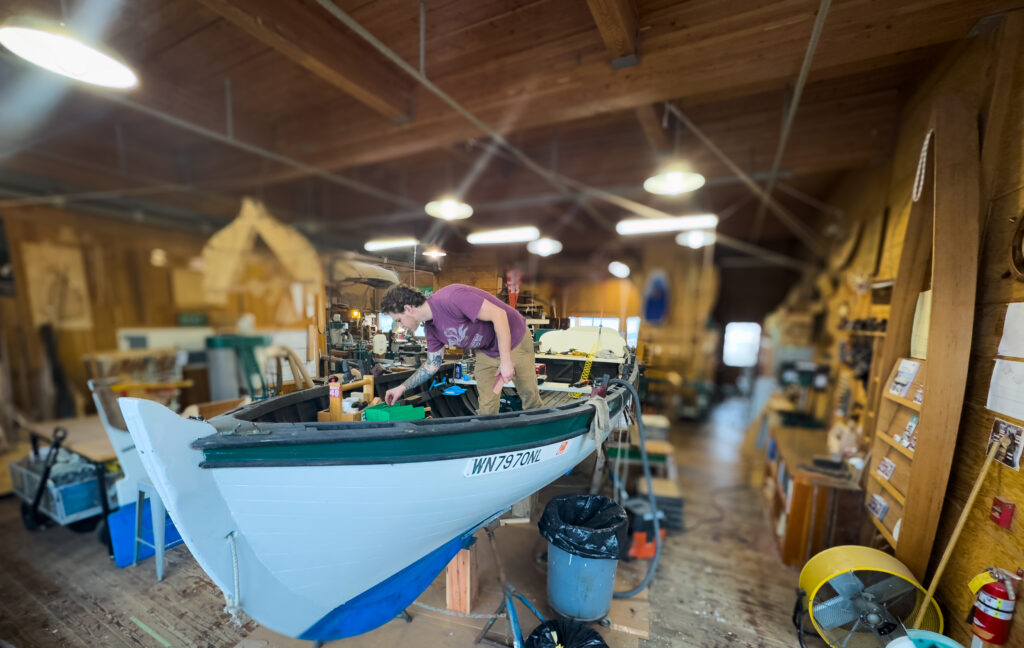
Our 26-foot longboat, Bear, is back in the Boatshop for her annual haulout—and this year, she’s getting some extra love. During routine maintenance, our team uncovered areas of rot that will require careful repair.
This project is being led by our Fleet Maintenance Manager, Sam Trocano, with skilled support from some of our dedicated Boatshop volunteers.
If you’re curious what goes into keeping a longboat like Bear shipshape, here’s an inside look at the assessment and the work ahead.
Longboat Bear Work Plan
Prepared by: Sam Trocano, NWM Fleet Maintenance Manager
Overview
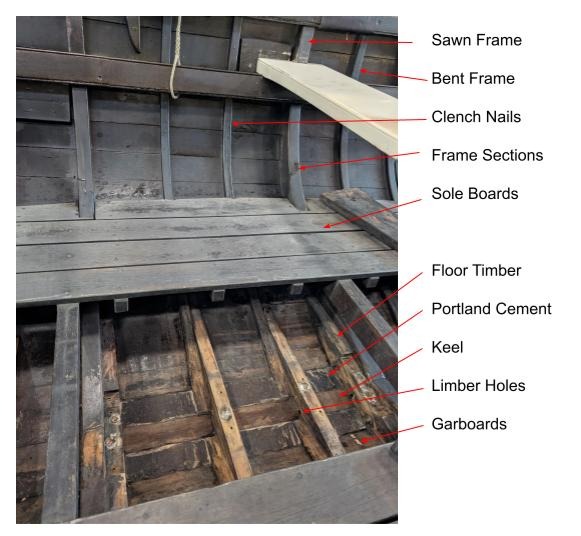
During Bear’s 2024–2025 annual maintenance haulout, rot was identified in the bilge areas. The most significant damage affects the majority of the smaller steam-bent frames. Additional deterioration is present in the floor timbers and several lower sections of the sawn frames. The garboards and keel appear to be in fair condition, though a full assessment will be necessary once repairs are underway.
These repairs are expected to be time-intensive, though not particularly material-heavy. Bear holds a five-year USCG Certificate of Inspection (COI) that renews in January 2026; the vessel must be ready by that date.
Construction details
Bear is carvel-planked with sawn frames spaced by two steam-bent oak frames. The sawn frames are fastened through the planking with silicon bronze wood screws (SBWS) and bolted through the floor timbers. The steam-bent frames are fastened with SBWS below the waterline, clench-nailed above the waterline, and copper-riveted through the floor timbers. The bilge is filled with Portland cement to the top of the softwood keel.
Test Repair
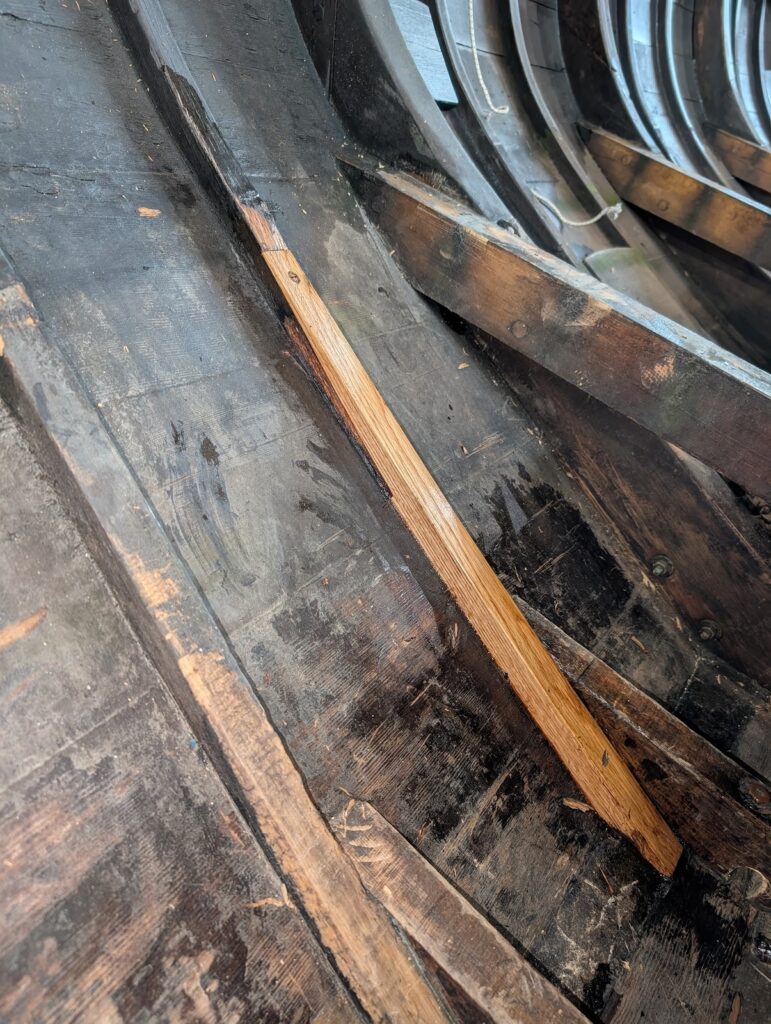
A test repair was performed on a single bent frame to assess repair methods and time requirements. After removing the exterior fasteners, the rotten section—approximately four planks up from the keel—was cut away. The rivets were also removed.
A nibbed scarf joint was chosen over a butt joint with a sistered section. This method is stronger and uses fewer fasteners and less wood. The new frame section was oiled, bedded in Dolphinite, and the end grain was sealed using a heated mixture of paraffin wax, pine tar, and oil. Based on this trial, the nibbed scarf appears to be the most efficient and durable approach.
Repair Plan
The repair scope includes bent frames, sawn frames, floor timbers, and possibly the garboards and keel.
- Bent Frames: Use nibbed scarf joints to replace rotten sections without fully removing the frames (avoiding clench nail removal and wooding the hull). Using a template, new scarfed sections can be made off the boat to facilitate batch production.
- Sawn Frames & Floor Timbers: These can be unfastened, patterned, remade, and reinstalled. Work should proceed in small, sequential sections to maintain hull integrity.
- Garboards & Keel (if necessary): If damage is found beneath the frames or timbers, it may be necessary to remove the lowest garboards and Portland cement to gain access and facilitate repair.
- Other Considerations: Logistics such as hauling, staging, cleaning, and component removal for access must be addressed prior to repair work.
Time and Materials
- ~30 steam-bent frame sections: Green oak, approx. ¾” x 1″ x 18″ each
- ~8 sawn frame lowers & ~8 floor timbers: Douglas fir, 2–3″ thick, maximize width for shape (source from PNW Timbers or similar)
- Fasteners: SBWS, copper rivets and roves
- Compounds: Bedding (Dolphinite or equivalent)
- Additional: Patterning materials, miscellaneous consumables
Estimated Labor:
Due to the variable scope and potential involvement with programmatic content, a precise labor estimate is difficult. A rough working estimate is approximately 240 hours of skilled labor.
After these repairs are complete, Bear will remain in the Boatshop for about another month for her regular maintenance—fresh oil, new paint, and other finishing touches—so she’ll be ready to use in our youth programs, like Maritime Discovery Program, summer camps, and Port Townsend Maritime Academy.