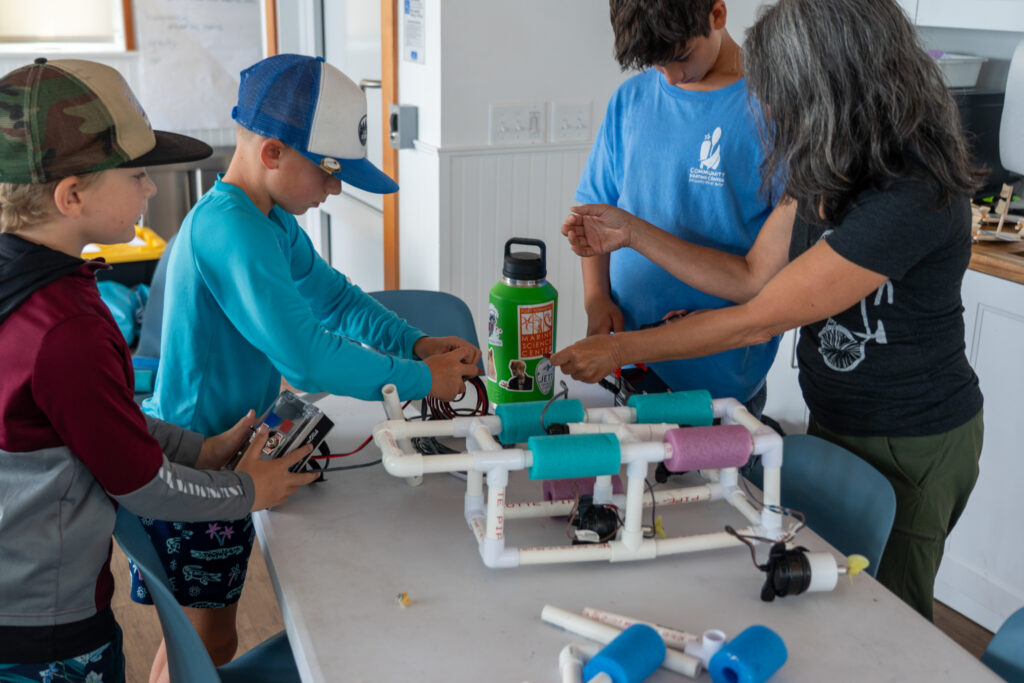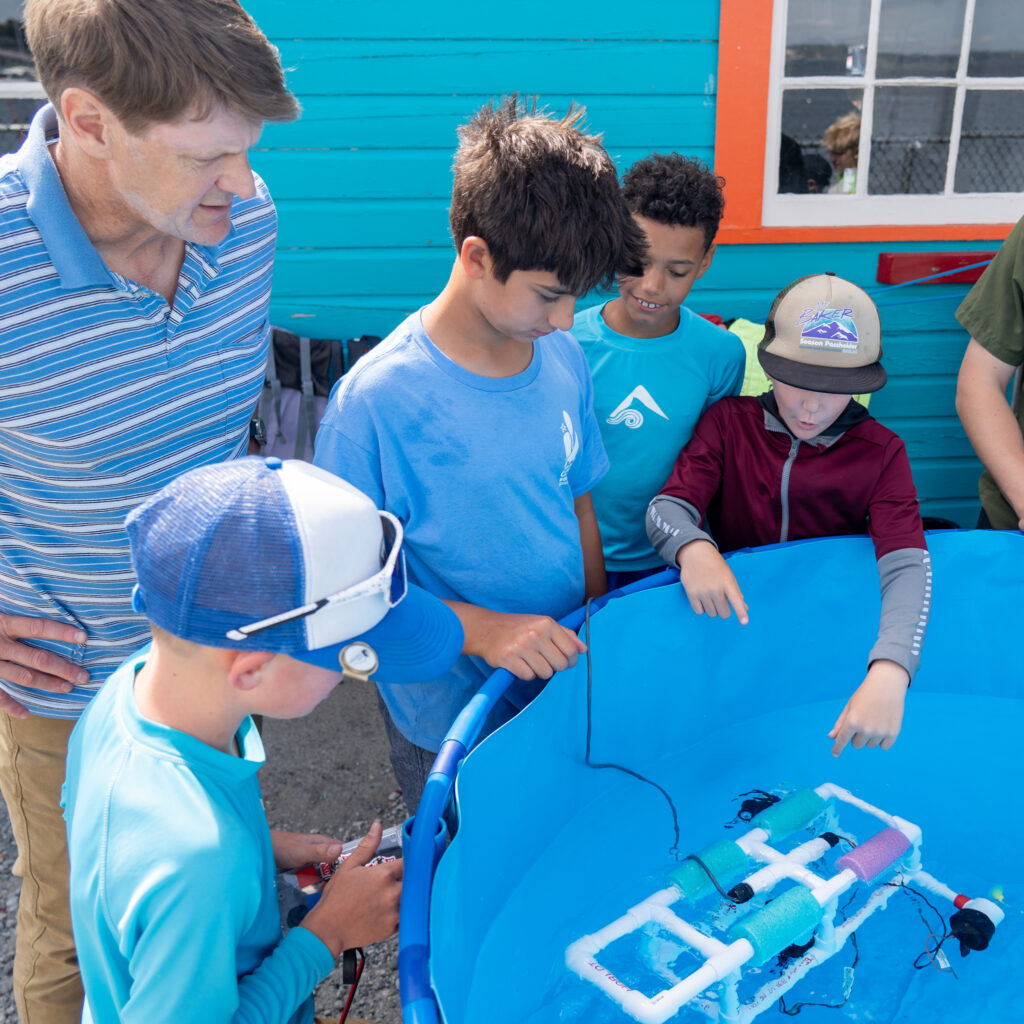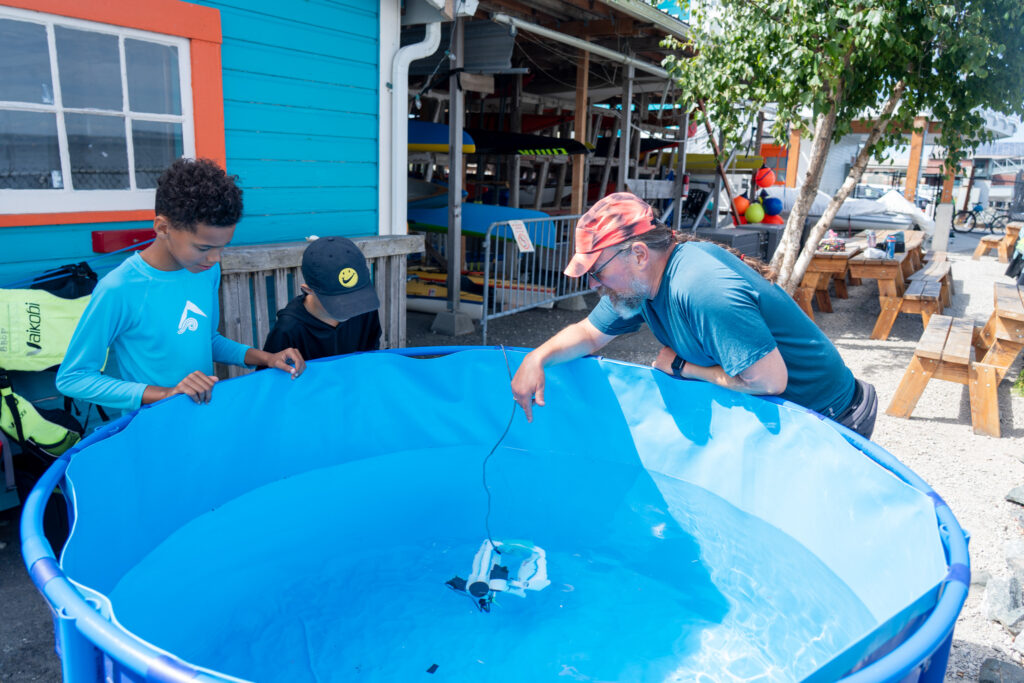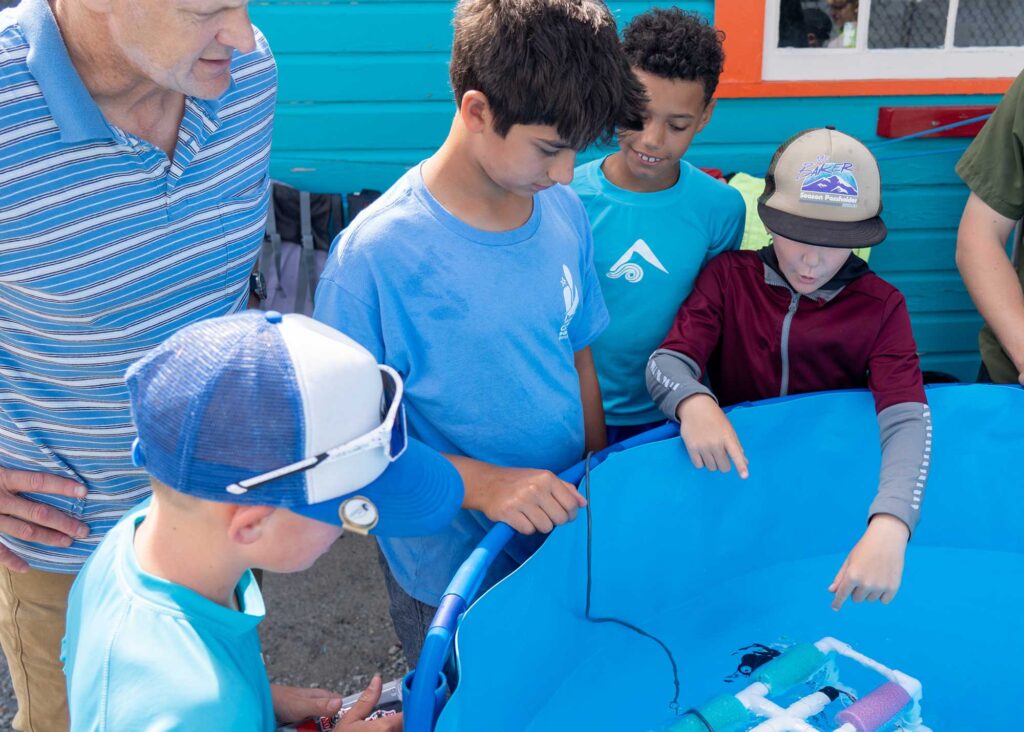
In August last year, a giant MegaSUP was tied to Taylor Dock, paddled over by a group of Middle Schoolers attending summer camp at the Community Boating Center. A small crowd of students leaned over the side, squealing with excitement as sea stars filled a screen in front of them. A student carefully guided a remotely operated vehicle (ROV) through the water below, while others shouted directions and pointed excitedly as purple and orange ochre sea stars, crabs and fish drifted into view. This wasn’t a lab or a classroom. It was science happening in real time on Bellingham Bay.
That moment says a lot about the Community Boating Center (CBC). Boats are what most people notice first, but they are really just the catalyst for discovery and community. CBC is about helping people experience the bay in a way that feels personal and shared. It is a place where curiosity is encouraged, questions are welcomed, and students don’t just learn about science, they do it.
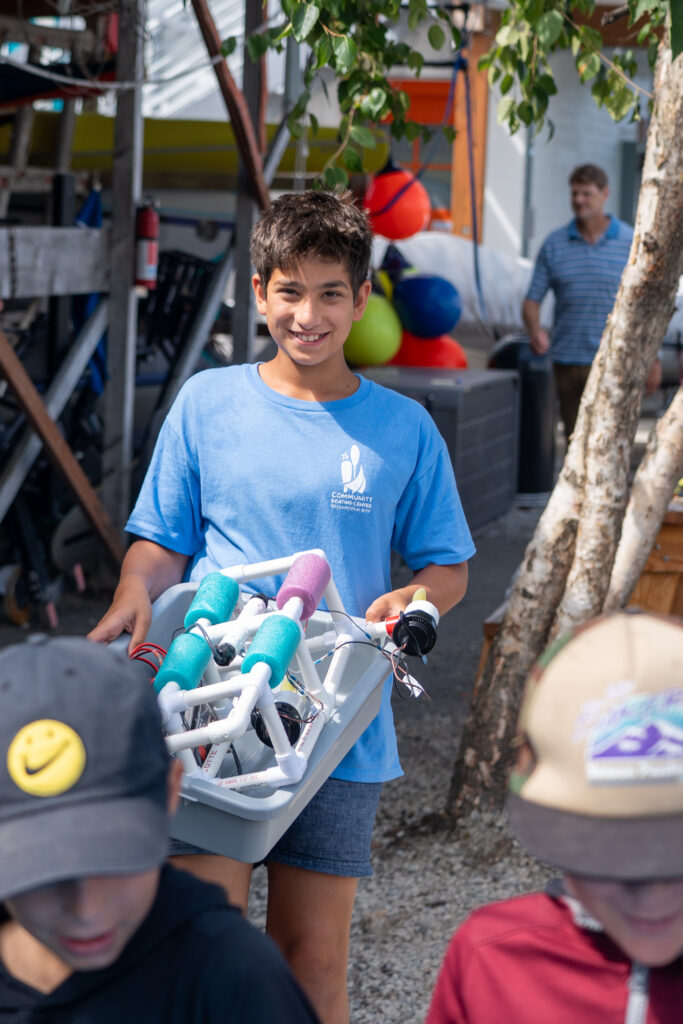
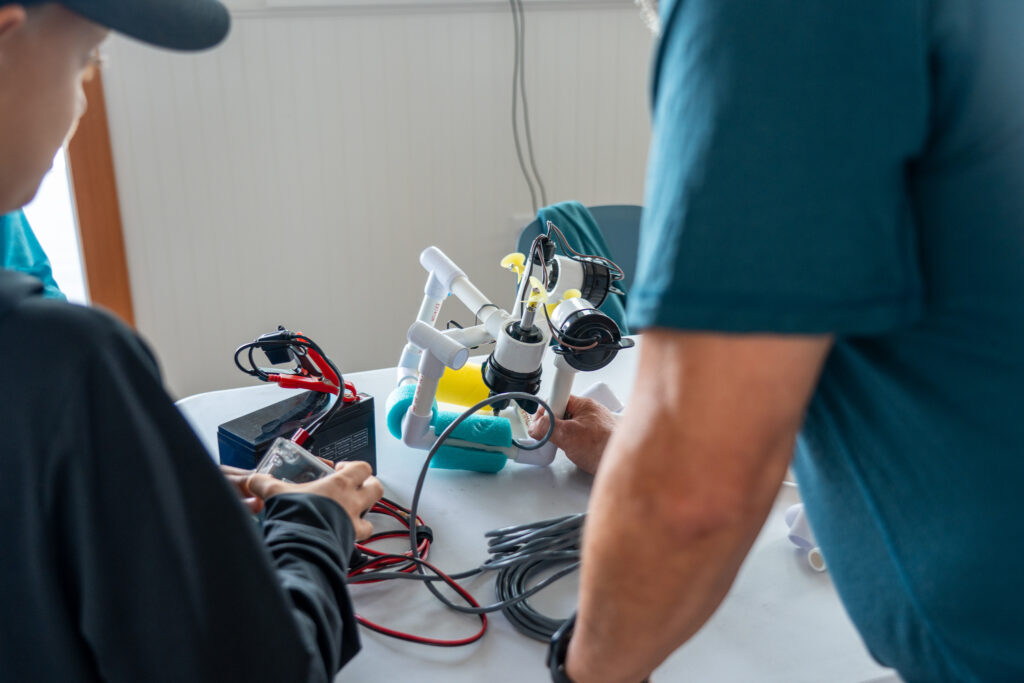
Owen, age 8, was part of that camp. It was his first time building an ROV, which his small group named “Platypus” because of its square body with a little “beak” coming off one side.
“I’m planning on building another ROV over winter break,” says Owen. “It was a really fun experience, and if people haven’t done it, they should.”
Owen’s Dad shared that Owen hopes to start a business with his ROV, looking at boat hulls for owners who may not want to snorkel or scuba dive.
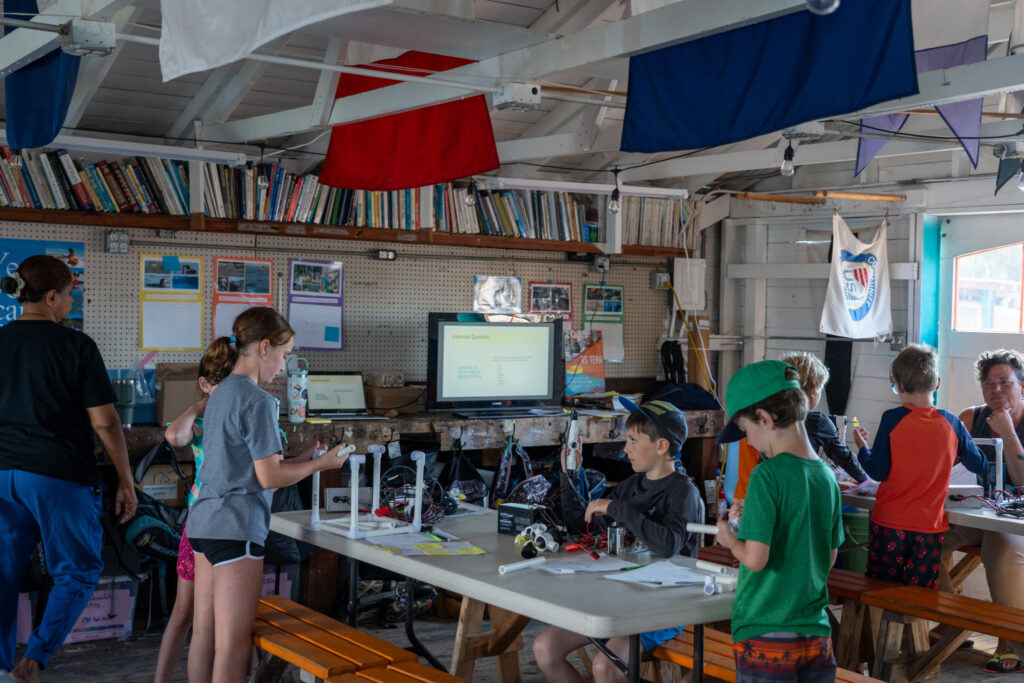
That day on the dock was part of Salish Sea Quest: Ocean Tech & Adventure Camp, a program created through a partnership between CBC and Western Washington University’s CREST project, Culturally Responsive Elementary Science Teaching. Funded by the National Science Foundation, CREST was designed to support more equitable science education by bringing together local elementary teachers, university researchers, and community partners.
At CBC, that collaboration came together in a very real way. Science teachers helped shape place-based lesson plans focused on marine engineering and ROV design, connecting what students were doing on the dock to statewide science standards. Alongside them, CBC instructors taught students how to paddle, sail, and stay safe on cold water- building confidence and comfort on the bay. Together they created an environment where science felt meaningful, hands-on, and connected to place.
“CREST’s partnership with the CBC allowed our teachers to become more familiar with the ROV lessons and experience teaching marine science right at Bellingham Bay,” says Josie Melton, CREST Co-Director. “We think learning about the marine environment and how to safely enjoy our local waters was a wonderful collaboration and we hope to partner again in the future.”
A guiding idea behind both CREST and CBC’s work is simple: people protect what they love. But love for a place doesn’t come from a book, It comes from being there, from feeling a sense of belonging and sometimes from getting splashed a little. Not everyone has the same lived experience or the same way of knowing and there is value in learning from one another. That is why access and culturally responsive teaching matters so much.
Fifty students participated in the CBC and CREST partnership, and the feedback spoke volumes. One parent, whose child attended on scholarship, shared:
“My 9-year-old daughter came home from Salish Sea Quest Camp absolutely glowing. She spent the week building an ROV, learning about marine ecosystems, and exploring the local waters by sail. It was the perfect blend of hands-on science, creativity, and adventure. What stood out most was how deeply she connected with the Salish Sea—she started noticing things in a whole new way. The counselors fostered such curiosity and confidence; she felt like a real marine scientist.”
That sense of belonging and confidence is exactly what CBC aims to create. When students see themselves reflected in learning, feel supported on the water, and are trusted to explore, science becomes something they can step into rather than observe from afar.
Learning That Extends Beyond the Water
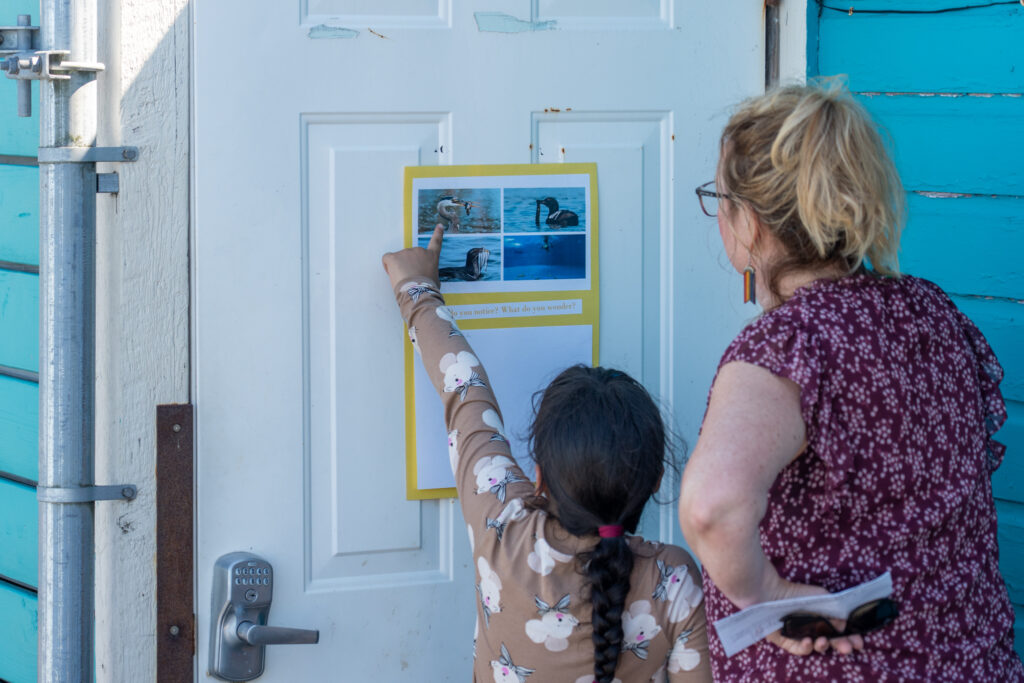
Not everyone’s entry point to the bay starts in a boat, and CBC knows that learning needs to happen both on the water and on shore. That’s why Tide Talks have become such an important part of CBC’s community programming.
Tide Talks are shore-side lectures and community events that invite people to keep learning. Hosted at CBC and led by scientists, educators, tribal knowledge holders, and local experts, Tide Talks create space for shared learning about the Salish Sea, marine ecosystems, climate, history, and stewardship.
These events are intentionally accessible, with live captions, a hearing loop, and a cozy atmosphere that often includes hot tea and time to lingering in conversation.
What’s Coming Next
As winter turns toward spring, CBC is preparing for another season of connection. Program registration opens February 15 at 5:00 pm, with opportunities to get on the water and stay engaged through shore-side learning. New offerings are being developed in partnership with NSEA, Wild Whatcom, and other local organizations, continuing to link education, recreation, science, and community care.